Fantasy Premier League is a free game in which a 15-player squad earns points from real Premier League performances. Success comes from meeting the squad rules, selecting the right eleven and captain before each deadline, and using free transfers and chips with a plan rather than reacting to one result.
The short answer
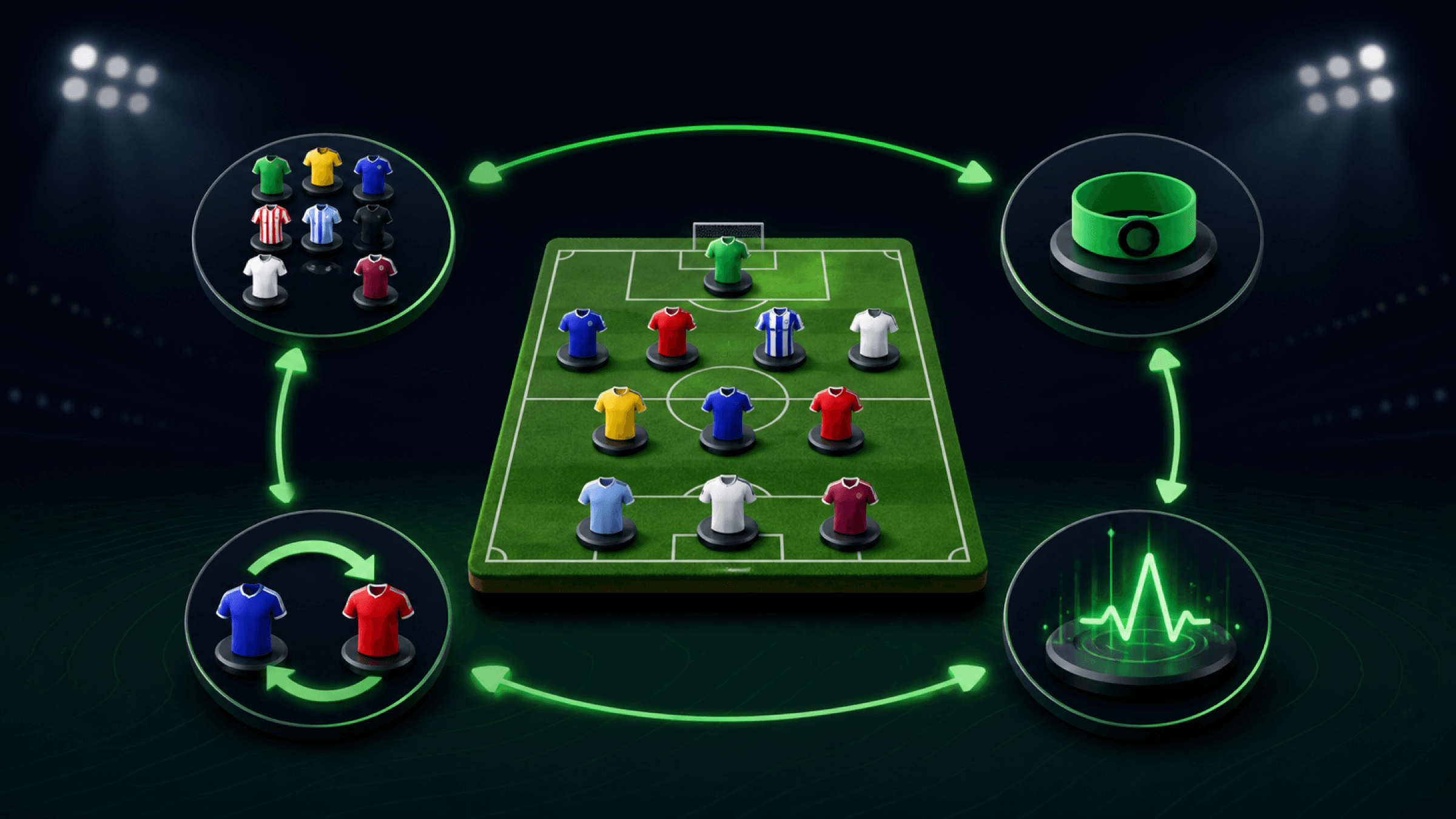
Fantasy Premier League, usually shortened to FPL, turns real Premier League matches into a season-long squad-management game. You receive £100.0m to select 15 players: two goalkeepers, five defenders, five midfielders and three forwards. You may own no more than three players from one club. Each Gameweek you choose a legal starting eleven, arrange your substitutes and name a captain and vice-captain before the published deadline.
Your players score when their real performances meet the game's scoring rules. Goals, assists, clean sheets, saves, defensive contributions and bonus can all matter, while cards, own goals, missed penalties and goals conceded can reduce returns. The captain normally scores double. FPL is therefore not a prediction contest alone: budget, minutes, fixtures, captaincy, transfers and bench cover must work together across many deadlines.
How it works
A Gameweek begins after one deadline and ends when its scheduled matches and scoring reviews are complete. Before the deadline you select the team that will score for you. A valid starting XI needs one goalkeeper, at least three defenders, at least two midfielders and at least one forward. The remaining four players form the bench. If a starter records no minutes, automatic substitutions can bring on an eligible substitute in bench order while preserving a legal formation.
Points players can earn
This is the quick 2026/27 scoring reference. Position matters for goals and clean sheets, while captaincy multiplies the final score after these points and deductions are applied.
- Appearance: 1 point for playing fewer than 60 minutes; 2 points for playing 60 minutes or more, excluding stoppage time.
- Goal: 10 points for a goalkeeper, 6 for a defender, 5 for a midfielder and 4 for a forward.
- Assist: 3 points, regardless of position.
- Clean sheet after 60+ minutes: 4 points for a goalkeeper or defender; 1 point for a midfielder.
- Goalkeeper saves: 1 point for every 3 saves.
- Penalty save: 5 points for the goalkeeper.
- Defensive contributions: 2 points for a defender reaching 10 clearances, blocks, interceptions and tackles; or for a midfielder/forward reaching 12 when ball recoveries are also counted. This award is capped at 2 points per match.
- Bonus: 1–3 points for the leading performers in each match under the Bonus Points System, subject to tie rules.
- Captaincy: the captain's final score is normally doubled; Triple Captain makes it three times the original score.
Points players can lose
- Penalty miss: −2 points.
- Goals conceded: −1 point for every 2 conceded by a goalkeeper or defender.
- Yellow card: −1 point.
- Red card: −3 points.
- Own goal: −2 points.
After the season starts, you normally receive one free transfer per Gameweek. Unused free transfers can roll up to five. Extra transfers beyond your available allowance cost four points each, commonly called a hit. A transfer should therefore improve more than one headline fixture: consider expected minutes, role, the next several opponents, injury status and what the money enables elsewhere. For 2026/27, official FPL says prices are locked until the Gameweek 1 deadline and its new predictor is guidance rather than a guarantee.
Bonus points go to the top performers in each match through the Bonus Points System. The top BPS player receives three bonus points, second gets two and third gets one, subject to tie rules. The 2026/27 BPS was adjusted after defensive contribution points arrived the previous season, so relying on an old scoring explainer can misstate how individual actions influence bonus. Use current official rules whenever a fine scoring detail affects a decision.
FPL also provides four chip types: Wildcard, Free Hit, Triple Captain and Bench Boost. For 2026/27, managers receive one set in each half of the season. The first set must be used before the Gameweek 19 deadline and cannot be carried into the second half; only one chip may be played in a Gameweek. A Wildcard permanently rebuilds the squad, while a Free Hit changes it for one Gameweek before the old squad returns. Triple Captain triples the captain score and Bench Boost counts the substitutes.
FPL points awarded for scoring a goal
The official 2026/27 goal-scoring award differs by the player's FPL position.
Key takeaway: A goalkeeper receives 10 points for a goal, compared with six for a defender, five for a midfielder and four for a forward.
View chart as a data table
| Goalkeeper | 10 pts |
|---|---|
| Defender | 6 pts |
| Midfielder | 5 pts |
| Forward | 4 pts |
A practical example
Imagine your draft contains a £15.5m premium forward, a £12.0m premium midfielder and an £8.0m defender. That core uses £35.5m, leaving £64.5m for twelve places. The correct question is not whether each premium is good in isolation. It is whether the remaining budget can still buy eleven likely starters, a legal bench and at least one captaincy route for the opening fixtures. If three cheap placeholders are unlikely to play, the structure may be too concentrated even when the stars project well.
On Friday, check the deadline and latest primary team news. Set a starting XI, then order the bench by the points you would genuinely expect if called upon. Choose the captain for expected points and minutes, not last week's score, and use the vice-captain on another secure starter. If a player is merely reported doubtful, preserve that uncertainty until the club or manager provides clearer information. Do not turn training photographs or silence into a fitness conclusion.
After the Gameweek, separate process from outcome. A well-supported captain can blank; a poor one can score. Record what information was available before the deadline, whether the player started and whether your assumptions about role and minutes were sound. Use that review to improve the next decision rather than chasing the previous week's points.
Common mistakes
The first mistake is spending all £100.0m on names while ignoring the formation and bench. A legal squad is not automatically a usable squad. The second is treating low ownership as proof of upside; ownership measures popularity, not future points. The third is making early transfers for fear of price changes before checking injuries, European matches and press conferences. A £0.1m saving rarely compensates for losing a player to late news or using a second transfer to repair the move.
Managers also overvalue last week's score and undervalue expected minutes. A substitute who scored in 20 minutes may remain a substitute; a 90-minute player who blanked may still have the better next decision. Avoid taking a four-point hit unless the replacement has a credible path to recover the cost and improve future Gameweeks. Finally, do not use a chip simply because it is available. The 2026/27 game again provides Wildcard, Free Hit, Triple Captain and Bench Boost in each half of the season, and only one chip can be active in a Gameweek.
- Do not miss the deadline; set a provisional team early.
- Do not confuse an official fact, a report, an expectation and a model projection.
- Do not build a bench of players with no realistic minutes.
- Do not chase a price predictor as though it guarantees a change.
- Do not judge every decision only by the final score.
Decision checklist
Use the same short routine every week. Confirm the deadline in your local time. Check official or attributable availability news. Review fixtures across more than one match. Compare expected minutes before projected points. Make transfers only after identifying the outgoing player, incoming player, cost and intended holding period. Set captain, vice-captain and bench order. Reopen the team after the last material press conference rather than assuming yesterday's draft is still current.
For chips, write the reason before activating one: what problem does it solve, what points source does it unlock and which later window are you giving up? For hits, compare the expected gain over the holding period with the four-point cost. For risky players, name a fallback at a similar price. This turns FPL from a stream of reactions into a repeatable decision process—and makes both good and bad outcomes easier to learn from.
Keep a small decision log with the date, evidence and intended review point. It can be as simple as: transfer made, player sold, player bought, free transfers remaining, expected holding period and the news that would reverse the move. Before confirming, check that the squad still fits the budget, position quotas and three-per-club rule. This habit catches mechanical errors and makes it possible to judge the quality of the decision later without rewriting what you knew at the time.
When official rules, scoring or chip deadlines change, update this guide visibly and record its new review date each season. Current primary-source information always overrides screenshots, old explainers and remembered rules from previous seasons.
How this article was checked
This guide summarises official Premier League and Fantasy Premier League information published for the 2026/27 game, including the £100m squad, transfers, captaincy, chips and changes to the Bonus Points System. It was reviewed against official pages on 6 August 2026. Examples are illustrative and do not represent a live recommended squad. Review the guide before the next season launch or sooner if official rules change.
- Fantasy Premier League — Official 2026/27 £100m budget and 15-player squad introduction.
- Fantasy Premier League — Official 2026/27 overview of scoring, transfers and points hits.
- Fantasy Premier League — Official 2026/27 Bonus Points System explanation and changes.
- Fantasy Premier League — Official 2026/27 chip allocation and usage rules.
- Fantasy Premier League — Official price-lock deadline and price predictor limitations.
- Fantasy Premier League — Official 2026/27 player scoring table, including points earned and deductions.