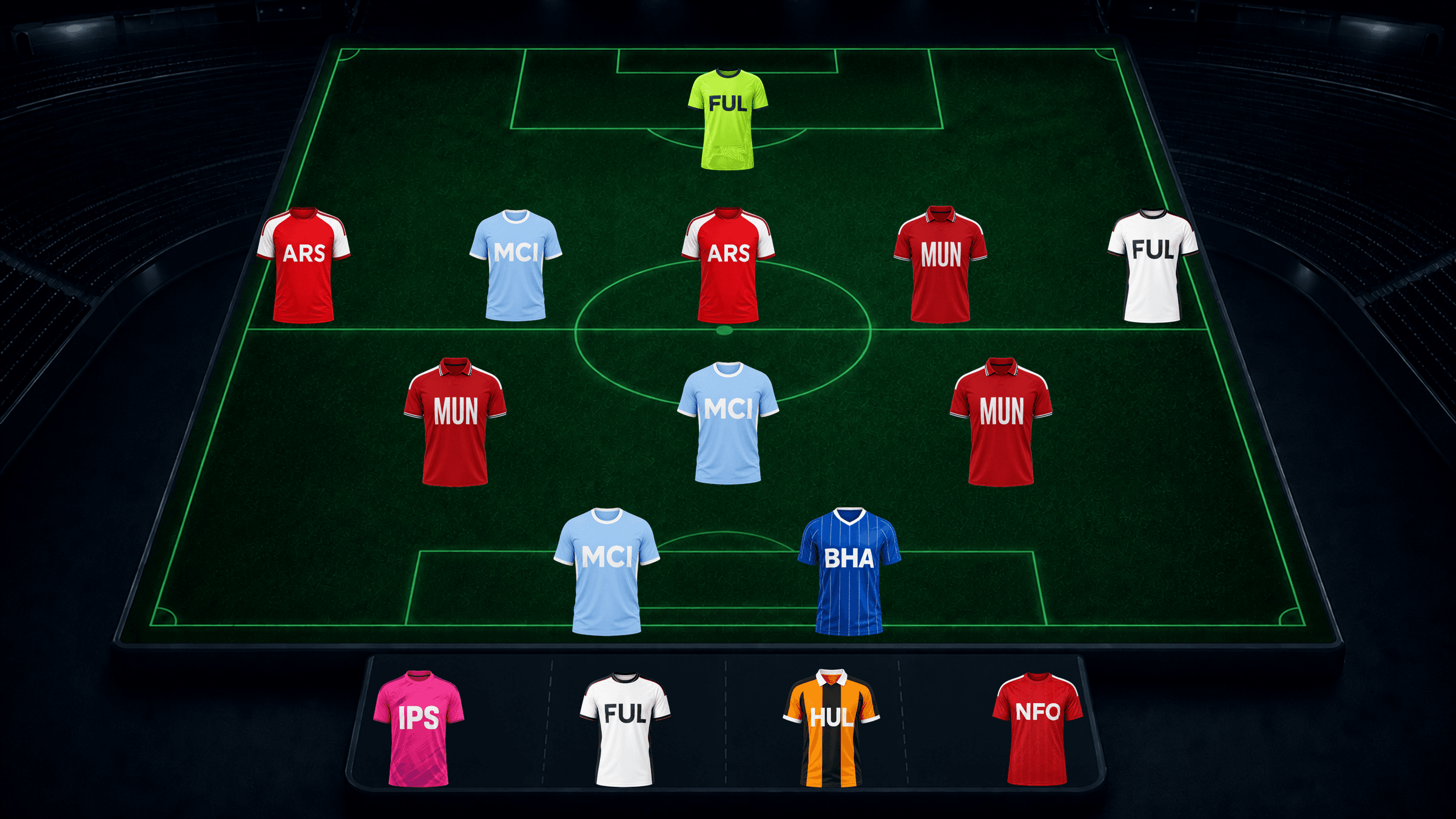
The first model build starts Haaland and Bruno together, adds Gabriel, O'Reilly and Mbeumo, and spends the full £100.0m. It is a structure test rather than a final team: Calafiori, Cherki and Kostoulas require further minutes evidence, while every selection must be rechecked after the remaining friendlies and press conferences.
The squad structure
The optimiser spends exactly £100.0m and produces a 5-3-2 starting shape: Leno; Gabriel, O'Reilly, Calafiori, Dalot and Robinson; Bruno Fernandes, Cherki and Mbeumo; then Haaland with Kostoulas up front. The bench is Palmer, Reed, Destan and Yates. Bruno narrowly leads Haaland for the current Gameweek 1 captain projection, 7.96 to 7.91, so the armband is a provisional model output rather than a settled recommendation.
The important result is the budget shape. Haaland at £15.5m and Bruno at £12.0m can coexist with Gabriel at £8.0m because the draft accepts a cheap bench and one £5.5m starting forward. That concentration improves the projected first XI but lowers resilience. If Kostoulas or Calafiori lose their expected roles, the structure needs a deliberate downgrade elsewhere rather than a like-for-like replacement that may not exist.
The original squad spent the full £100.0m. That left no bank for an upgrade without a downgrade elsewhere. The archive contains one selected squad, not a second optimised version with £0.5m held back, so it cannot quantify the projection cost of buying that flexibility.
Goalkeepers and defence
Leno is the starting goalkeeper at £4.5m, with 10.81 projected points and 87.3 expected minutes per match across the opening three. Palmer is a £4.0m bench goalkeeper whose value is budgetary; this draft does not assume rotation. A safer pairing would spend an extra £0.5m on two credible starters, but that money must come from a named outfield slot.
The defence carries much of the draft's upside. Gabriel projects 17.99 points, O'Reilly 17.58, Calafiori 15.67, Dalot 13.45 and Robinson 12.98. The weakness is that projections are not equal to security: Gabriel and O'Reilly are above 84 expected minutes, Dalot 79.2, Robinson 68.8 and Calafiori 62.3. Starting all five maximises the model score, but replacing one volatile defender with a safer £4.5m–£5.0m option may improve resilience.
Starting five defenders concentrated the decision on the fifth defensive slot. A cheap attacker gaining a dependable role could have made a different formation attractive, but no alternative formation is quantified in this archived result. The 5-3-2 is the saved selection, not evidence that five defenders are always optimal.
- Start: Leno — £4.5m.
- Bench: Palmer — £4.0m.
- Defence: Gabriel £8.0m, O'Reilly £6.5m, Calafiori £5.5m, Dalot £5.0m, Robinson £4.5m.
Projected contribution from the starting defence
The five defenders selected by the frozen £100m squad optimiser, compared over the opening three Gameweeks.
Key takeaway: The optimiser concentrates defensive projection in Gabriel and O'Reilly; Calafiori ranks third but carries the lowest expected-minutes figure of the five.
View chart as a data table
| Gabriel | 17.99 pts | £8.0m · 89.6 xMins |
|---|---|---|
| O'Reilly | 17.58 pts | £6.5m · 84.9 xMins |
| Calafiori | 15.67 pts | £5.5m · 62.3 xMins |
| Dalot | 13.45 pts | £5.0m · 79.2 xMins |
| Robinson | 12.98 pts | £4.5m · 68.8 xMins |
Midfield and forwards
Bruno is the midfield anchor at £12.0m and leads the current GW1 captain projection. Mbeumo at £8.0m provides a second United route, while Cherki at £7.5m provides City attack without another premium price. The cheap midfield places are Reed and Yates at £4.5m. Reed has the stronger three-match projection and is first in the outfield bench order; Yates is purely a budget enabler in this version because the model gives him only 46.4 expected minutes per match.
Haaland is the starting forward and vice-captain, backed by 24.62 xPts over three fixtures. Kostoulas starts at £5.5m, while Destan at £4.5m is the second bench outfielder. Kostoulas projects 12.75 points but only 64 expected minutes, so this is the key compromise. A move to a more secure £6.0m–£8.0m forward would require money from Calafiori, O'Reilly, Mbeumo or Cherki; that alternative should be tested after the final friendly evidence.
The midfield is deliberately narrow because the optimiser values the fifth defender and second forward. That makes Bruno and Mbeumo especially important: an unexpected United role change affects two starting positions at once. A diversified version with Gibbs-White or another secure-minute midfielder may be preferable even if its raw total is slightly lower. Correlated upside can be useful, but correlated selection risk should be visible rather than hidden inside the total projection.
Bench and flexibility
The bench order is Reed first, Destan second and Yates third, with Palmer the reserve goalkeeper. It costs the minimum practical amount and protects the premium core, but it is not robust. Reed and Destan have plausible appearance routes; Yates does not currently project enough minutes to be trusted for an automatic-substitution rescue. Managers who prefer resilience should turn £0.5m–£1.0m of defensive spend into a stronger fourth substitute.
Club slots also matter. The draft uses three City players—Haaland, O'Reilly and Cherki—and three United players—Bruno, Mbeumo and Dalot. Any late City or United breakout therefore requires a transfer out from the same club. The Arsenal allocation is Gabriel and Calafiori, leaving one slot open. That flexibility has real value while Saka's fitness and the forward hierarchy remain uncertain.
Bench quality should be evaluated by scenarios, not total projected points. Test what happens if one defender is unexpectedly benched, if a starting midfielder misses the opening fixture and if the cheap forward plays only a late cameo. Reed can cover one absence in principle, but two simultaneous doubts expose Yates or Destan. A modest downgrade from a premium defender may improve expected points in those failure states even if it reduces the base-case optimum.
Planned changes before deadline
Calafiori’s 62.3 expected minutes, Cherki’s 68.5 and Kostoulas’s 64 were the main selection vulnerabilities. A weaker role for any of them would have reduced the appeal of the premium-heavy structure. Bruno and Haaland were separated by just 0.05 displayed GW1 xPts, so the provisional captain choice was also sensitive to small assumption changes.
This version should not be copied blindly. It is a transparent baseline showing what the model buys when asked to maximise a weighted starting XI within the official rules. Compare it with a safer-bench version and a one-premium version. Prices are locked until the GW1 deadline, so evidence—not fear of a rise—should drive every final alteration.
The clearest failure case was two unexpected absences: the cheap bench would then have to supply more than one useful replacement. Reducing defensive spend could improve that cover, but this article does not contain a second solver result proving the best swap. Its lasting value is the visible trade-off between premium starters and bench resilience, with the original selection preserved.
How this article was checked
The squad was selected from the accepted 6 August FPLRogue three-Gameweek projection feed using a mixed-integer optimiser. Constraints enforce a £100.0m maximum budget, two goalkeepers, five defenders, five midfielders, three forwards, no more than three players per club and a legal starting formation. The objective weights starting-XI xPts more heavily than bench xPts and adds the best current Gameweek 1 captain projection. It does not know future press conferences, final friendly roles or the editor's risk preference.
- FPL Rogue data and models — Three-Gameweek player projections, prices, ownership and expected minutes.
- FPL Rogue data and models — Accepted model engine, version and projection freshness.
- Fantasy Premier League — Official players, prices, positions, teams, availability flags and Gameweek deadline.
- Fantasy Premier League — Official 2026/27 £100m budget and 15-player squad introduction.
- Fantasy Premier League — Official price-lock deadline and price predictor limitations.