Haaland and Bruno justify the premium conversation, but the richest value cluster sits in defence and the £7.0m–£8.0m midfield. Cheap picks should be judged by usable minutes rather than price alone: Leno, Robinson and Van den Berg currently offer firmer routes than the most speculative £4.0m–£4.5m enablers.
The price-band verdict
The model does not say to buy the cheapest player in every position. It says to pay for the few assets whose projection or role cannot be reproduced cheaply, then use reliable value to fund them. Haaland's 24.62 three-match xPts and Bruno's 22.31 create the premium decision. Gabriel's 17.99 at £8.0m is expensive for a defender, but his projection and 89.6 expected minutes distinguish him from less secure Arsenal routes.
Below that tier, midfield is deep. Cherki, Mbeumo, Semenyo, Gibbs-White, Doku, Cunha and Rice all sit between £7.5m and £8.5m with 14.8–17.4 xPts. Defence offers usable £4.5m–£5.0m routes, while the budget-forward pool is thinner and more dependent on role assumptions. That asymmetry favours spending on a premium forward, selecting two or three mid-priced midfielders and avoiding a bench made entirely of minimum-price players with uncertain minutes.
Price bands are position-specific because £6.0m buys a premium goalkeeper, a mid-priced defender, a budget midfielder or a budget forward. Comparing all players on one points-per-million list would reward mandatory baseline spending and misstate opportunity cost. The useful comparison is the upgrade from the best viable cheaper option in the same squad slot. That is why Gabriel must justify the money over a £4.5m–£5.0m defender, not over a goalkeeper or an unplayable minimum-price midfielder.
Premium options
Haaland is the premium forward benchmark at £15.5m. His value is not raw points per million; it is the combination of the model's highest three-match total, strong expected minutes and immediate captaincy access. Bruno at £12.0m is the flexible premium midfielder. He projects only 2.31 points fewer and releases £3.5m, enough to turn two weak starters into credible mid-priced options. Owning both is viable, but it makes the cheap-player evidence more important.
Saka is the next premium midfielder at £9.5m and 16.82 xPts, but his 70.8 expected minutes and prior fitness-management evidence prevent a clean recommendation today. Gabriel is the premium defender to beat: 17.99 xPts, 89.6 expected minutes and a strong opening fixture. Raya leads the premium goalkeepers at £6.0m and 12.82 xPts, though the gap to £4.5m Leno is only about two points across three matches, making goalkeeper an obvious place to save when the money has a stronger outfield use.
Premium ownership also changes transfer friction. Haaland and Bruno are expensive to reach after spreading their budget across several players, and both can become captaincy options immediately. Gabriel is easier to obtain with one defensive move, while Raya can usually be reached by reallocating goalkeeper spend. Managers should therefore distinguish a premium worth starting with from one that is merely attractive. Initial access is most valuable when the replacement route would otherwise require two transfers or a points hit.
- Haaland — £15.5m, 24.62 xPts.
- Bruno Fernandes — £12.0m, 22.31 xPts.
- Gabriel — £8.0m, 17.99 xPts.
- Raya — £6.0m, 12.82 xPts.
Price versus projected points in the opening shortlist
Price and three-Gameweek expected points for the premium, mid-priced and budget examples recorded in this article.
Key takeaway: The premium pair lead raw projection, while Cherki is the highest projected example below £8.0m and Robinson leads the £4.5m outfield examples shown.
View chart as a data table
| Haaland | 15.5 | 24.62 | Premium |
|---|---|---|---|
| B. Fernandes | 12 | 22.31 | Premium |
| Gabriel | 8 | 17.99 | Premium |
| Cherki | 7.5 | 17.41 | Mid-priced |
| Mbeumo | 8 | 16.25 | Mid-priced |
| Thiago | 8 | 15.14 | Mid-priced |
| Dalot | 5 | 13.45 | Mid-priced |
| Robinson | 4.5 | 12.98 | Budget |
| Kostoulas | 5.5 | 12.75 | Budget |
| Leno | 4.5 | 10.81 | Budget |
| Reed | 4.5 | 10.57 | Budget |
Mid-priced options
Mbeumo is the cleanest £8.0m midfield route in the current feed, combining 16.25 xPts with a 100 per cent starting probability and 76.3 expected minutes. Gibbs-White offers a more secure 88.1 expected minutes at the same price but a lower 15.29 xPts. Cherki leads the £7.5m group at 17.41 xPts; Doku is at 15.22 and Rice at 14.80. Cherki's higher projection arrives with 68.5 expected minutes, so the choice is upside versus role security rather than a simple ranking.
In defence, O'Reilly at £6.5m sits just above our mid-price cut-off but behaves like a value premium: 17.58 xPts and 84.9 expected minutes. Dalot at £5.0m projects 13.45 with strong opening fixtures, while Van den Berg at the same price projects 12.92 and 84.1 expected minutes. At forward, Thiago at £8.0m projects 15.14 with 86.9 expected minutes, and Gyökeres at £7.5m projects 14.24 but only 66.3 expected minutes. Watkins is the secure-minutes alternative at £8.0m and 13.88 xPts.
This middle tier is where managers can express risk appetite without breaking the squad. A high-upside build can pair Cherki with Gyökeres and accept managed minutes; a secure-minutes build can favour Gibbs-White, Thiago or Watkins. The better choice depends on bench strength and captaincy coverage. When two options are close, prefer the player whose price allows a simple switch rather than one who traps money in a narrow band with no credible replacement.
Budget options
Leno is the practical budget goalkeeper at £4.5m: 10.81 xPts and 87.3 expected minutes. Robinson is the headline £4.5m defender at 12.98 xPts, but Castagne at the same price carries more expected minutes—79.5 versus 68.8—with a nearly identical 12.81 projection. That is exactly why price-band analysis must include role evidence. A small model gap can be less important than an extra ten dependable minutes per match.
The forward enablers are riskier. Kostoulas costs £5.5m and projects 12.75 points from 64 expected minutes. Destan costs £4.5m and projects 10.07 from 74.7 expected minutes. Both can enable a premium structure, but neither should automatically be treated as a set-and-forget starter. At £4.5m in midfield, Reed projects 10.57 with 62.8 expected minutes; Yates projects 8.37 with only 46.4. The cheaper the slot, the more important it is to state whether it is a starter, rotation piece or pure budget placeholder.
A budget player also needs an exit route. If a £4.5m midfielder loses his place, the next reliable option may cost £5.0m or £5.5m, forcing a second transfer. Leaving £0.5m in the bank or selecting a genuinely playable first substitute can be worth more than squeezing the last projected decimal from the starting XI. Classify each cheap selection as starter, rotating starter, first substitute or non-playing enabler so the risk is explicit.
Best squad structures
The opening budget choices were a double-premium structure, a Haaland-led structure with cheaper midfielders, or a Bruno-led structure without Haaland. Moving from Bruno at £12.0m to Mbeumo at £8.0m released £4.0m; moving from Haaland to a cheaper forward released a different amount depending on the replacement. These are allocation options, not three independently verified complete squads.
The model's first legal draft chooses double premium, yet that is not proof the structure will remain best. The final decision turns on the cheap slots. If Kostoulas, Robinson and the £4.5m midfielders gain reliable roles, double premium becomes easier to defend. If those minutes weaken, one premium should become two secure starters. Review every price band after final team news, and judge changes by what the whole squad gains—not by whether an isolated player's projected points per million look attractive.
The cheap starters determined how resilient each option was. Cherki’s 68.5 expected minutes and Kostoulas’s 64 left less room for a non-playing bench than a structure built around more secure roles. The saved chart cannot price every possible replacement, so it supports comparisons between the named players rather than a definitive ranking of full squads.
The goalkeeper choice provides one concrete opportunity cost: Raya’s £1.5m premium over Leno bought about two projected points across three matches. In defence, Gabriel’s £3.5m premium over Robinson bought 5.01. Those are different budget decisions, and neither automatically dominates an attacking upgrade. A manager needed the remaining squad to identify where the next pound was most useful.
Opening targets: the squad-slot trade-off
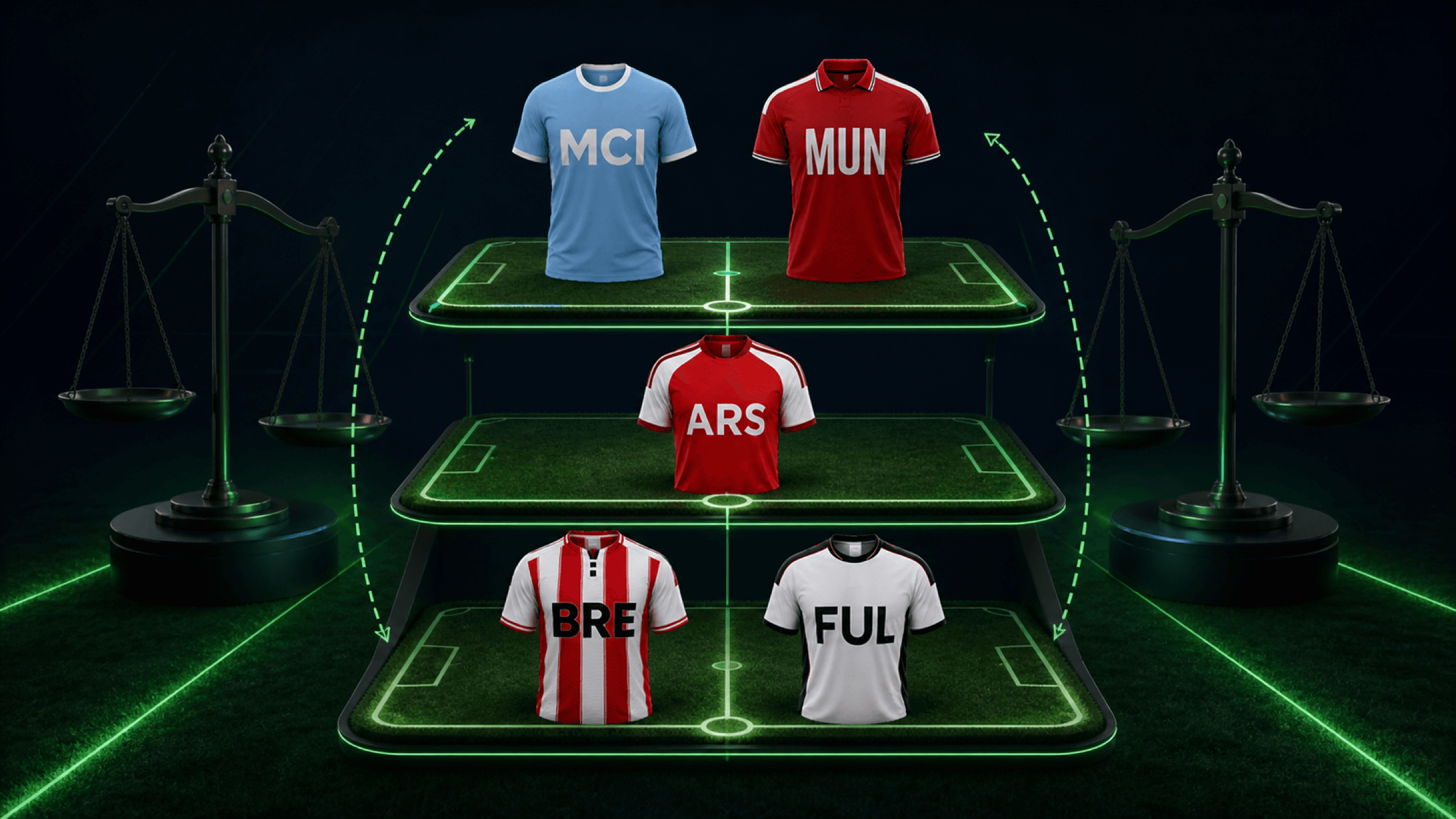
The 6 August opening-targets comparison also highlighted access: Haaland, Cherki and O'Reilly would use all three City slots, while Bruno and Mbeumo would concentrate two midfield places in United. A player with a good individual projection was not automatically an available fourth route into the same club.
The defensive comparison also separated price from playing time. Calafiori cost £5.5m with 62.3 expected minutes, against Gabriel at £8.0m with 89.6. The £2.5m saving bought budget flexibility while accepting a weaker minutes estimate. Before the opening deadline, removing a player from a draft did not incur a transfer hit; these were squad-building options, not urgent sales.
How this article was checked
Prices, ownership and positions come from official FPL data captured with the accepted 6 August FPLRogue projection feed. The comparison horizon is Gameweeks 1–3. For this guide, premium means goalkeepers £5.5m+, defenders £6.0m+, midfielders £9.0m+ and forwards £9.0m+; mid-priced means GK £4.5m–£5.0m, DEF £5.0m–£5.5m, MID £6.5m–£8.5m and FWD £6.0m–£8.5m; budget is below those cut-offs. Value combines projected points, price, expected minutes and structural opportunity cost.
- FPL Rogue data and models — Three-Gameweek player projections, prices, ownership and expected minutes.
- FPL Rogue data and models — Accepted model engine, version and projection freshness.
- Fantasy Premier League — Official players, prices, positions, teams, availability flags and Gameweek deadline.
- Fantasy Premier League — Official 2026/27 £100m budget and 15-player squad introduction.
- Fantasy Premier League — Official price-lock deadline and price predictor limitations.
- Fantasy Premier League — Attributed England update explaining that Bukayo Saka's fitness still required management in June.