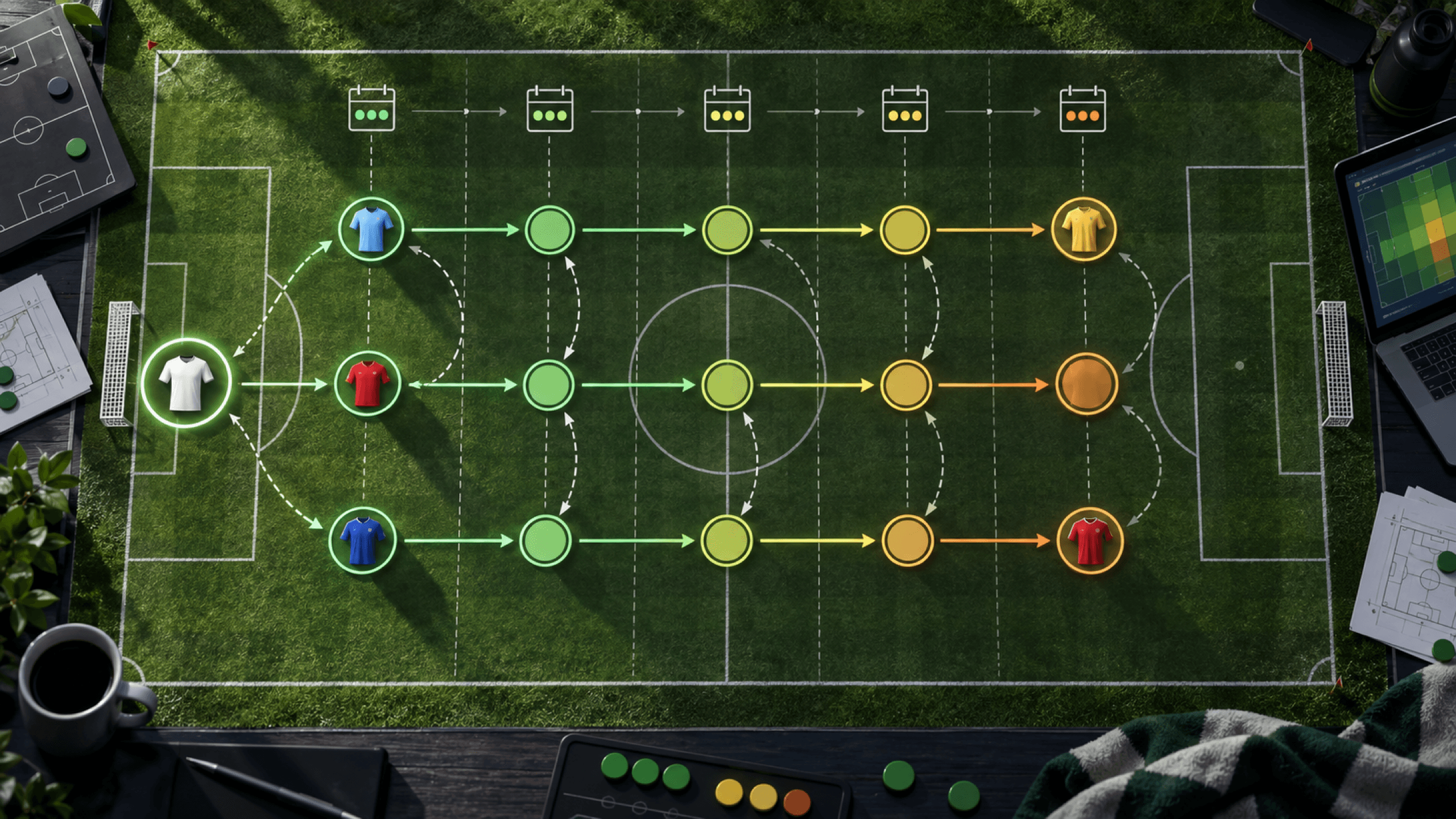
Target City's attack, add one Forest route if it fits, and preserve flexibility for the international break. Avoid hits for short-lived defensive doubles.
The fixture verdict
GW5 is a week for targeting the obvious home strengths while keeping one eye on October. Manchester City host Sunderland, Forest host Coventry and Everton host Ipswich; those are the cleanest places to look for immediate FPL leverage. Manchester United's trip to Fulham and Arsenal's visit to Brighton still contain excellent individual players, but the fixture itself is less generous.
The Friday deadline and Brentford-Chelsea opener add a planning wrinkle. Managers receive less late-week breathing room, while the international break that follows GW5 stretches the wait to GW6. Buy players you would be comfortable owning through that pause. A transfer that expires on Sunday evening is less a plan than a weekend rental with awkward paperwork.
Fixture analysis works best when it narrows decisions rather than decorating them. A favourable opponent raises the appeal of good roles; it does not turn every squad player into a transfer target. City and Forest lead because their strongest assets combine the match-up with credible minutes and routes to points. The badge on the ticker opens the conversation, but the player closes it.
Best attacks to target
City are the best attack to target. Haaland leads the entire slate at 9.00 xPts and Cherki reaches 6.52, giving a premium and mid-price route into the Sunderland fixture. Forest are next for one-week concentration: Gibbs-White's 7.20 makes him the headline midfielder, while their defenders also benefit from the match-up.
United's Bruno Fernandes projects at 7.16 away to Fulham, proof that a player's role can outrun an average-looking fixture. Everton's Barry at 5.43 offers a cheaper home route against Ipswich. Arsenal remain a hold rather than an aggressive buy for Brighton away: Saka's 5.56 is respectable, but not enough to elbow aside the stronger City and Forest priorities.
Brentford against Chelsea is the deadline-night complication. Because it begins on Friday, neither side benefits from later weekend information, and managers need their final evidence before the early lock. Chelsea attackers may still appeal on role, but this article does not force them above stronger projections simply because they occupy the first television slot.
GW5 best attacks to target: model shortlist
One frozen production-model refresh; expected outcomes are not single-match promises.
Key takeaway: The table compares projected points, expected minutes and start probability for the article shortlist.
| Position | ||||||
|---|---|---|---|---|---|---|
| DEF | Muñoz | NFO | 6.66 pts | 80.7 mins | 96.6% | Coventry City H |
| DEF | N.Williams | NFO | 6.31 pts | 89.1 mins | 99.5% | Coventry City H |
| DEF | Guéhi | MCI | 6.12 pts | 89.3 mins | 99.2% | Sunderland H |
| MID | Cherki | MCI | 6.52 pts | 81.9 mins | 97% | Sunderland H |
| MID | Gibbs-White | NFO | 7.2 pts | 88.6 mins | 99.4% | Coventry City H |
| MID | B.Fernandes | MUN | 7.16 pts | 86.3 mins | 96.5% | Fulham A |
| FWD | Haaland | MCI | 9 pts | 87.6 mins | 99.5% | Sunderland H |
| FWD | Barry | EVE | 5.43 pts | 85.4 mins | 98% | Ipswich Town H |
Best defences to target
Forest provide the standout defensive target. Muñoz, Neco Williams, Diomande, Murillo, Aina and Sels all sit above five projected points, though their minutes security varies sharply. The best route is one defender with a strong start probability, not a triple-up built on the assumption that Coventry will politely decline to shoot.
Manchester City are the other premium defence. Marc Guéhi projects at 6.12, Nico O'Reilly at 5.81 and Matheus Nunes at 5.26. Again, expected minutes separate the useful picks from the decorative ones. Goalkeepers and defenders should be judged on clean-sheet probability plus role; a green fixture icon cannot substitute itself on after 58 minutes.
Defensive double-ups are particularly sensitive to correlation. Two defenders from the same club can deliver a large rank gain when the clean sheet lands, but both lose the same four points when it does not. Managers already holding one Forest defender should compare a second with City's alternative rather than pretending the choices are independent. Diversification is not glamorous; neither is watching one Coventry goal erase an hour's optimism twice.
Fixture swings
The first swing is Forest: Coventry now, then a less friendly run that includes Arsenal in GW7. That makes Gibbs-White or one defender a calculated short-term buy, but argues against overcommitting. City's route is easier to hold because both Haaland and their leading defenders retain premium-team upside beyond one opponent.
The second swing is calendar-based. GW6 does not arrive until 10 October, so injuries and role changes can develop during the break. Banked transfers gain value when information is scarce. Managers wildcarding later can attack GW5 more aggressively; everyone else should favour picks whose case survives a fortnight without league football and several thousand air miles.
The international break increases uncertainty and also increases the value of information. Roles can change, players can return late and new injuries can emerge. Buying a secure starter now protects the squad from some of that noise. Booking a transfer out immediately after GW5 does the opposite, spending future flexibility before the next set of facts has arrived.
Planning the transfers
Plan transfers in three layers. First, fix confirmed absences such as Foden's suspension. Second, add one high-confidence route from City or Forest. Third, preserve flexibility for the international break. Haaland captainers already own the best City attack; they need not force a second move merely to feel involved.
Our practical order is City attack, one Forest route, then value at Everton or a role-led premium such as Bruno. Avoid hits for short-lived defensive doubles and avoid selling strong long-term assets for a single green square. Fixtures are a map, not the destination. The manager who keeps enough transfers to change direction usually enjoys the journey more than the manager arguing with a broken sat-nav.
Finally, separate a fixture swing from a player swing. Forest's schedule can worsen while Gibbs-White remains a useful talisman; City's schedule can look fine while a defender loses minutes. Plan with both layers. A coloured run of opponents is a useful map, but the route still depends on who is driving and whether the manager gives him the keys.
How this article was checked
Model tables use one frozen production refresh and report expected outcomes, not certainties. Official FPL feeds supply fixtures, prices, ownership and availability; late team news can change expected minutes and the recommendations.
- Fantasy Premier League — Official FPL player, price, ownership, availability and deadline data.
- Fantasy Premier League — Official GW5 fixtures, opponents and kickoff times.
- FPL Rogue data and models — Frozen GW5 xPts, xMins and start probabilities used in the article.
- Premier League — Premier League 2026/27 fixture schedule.