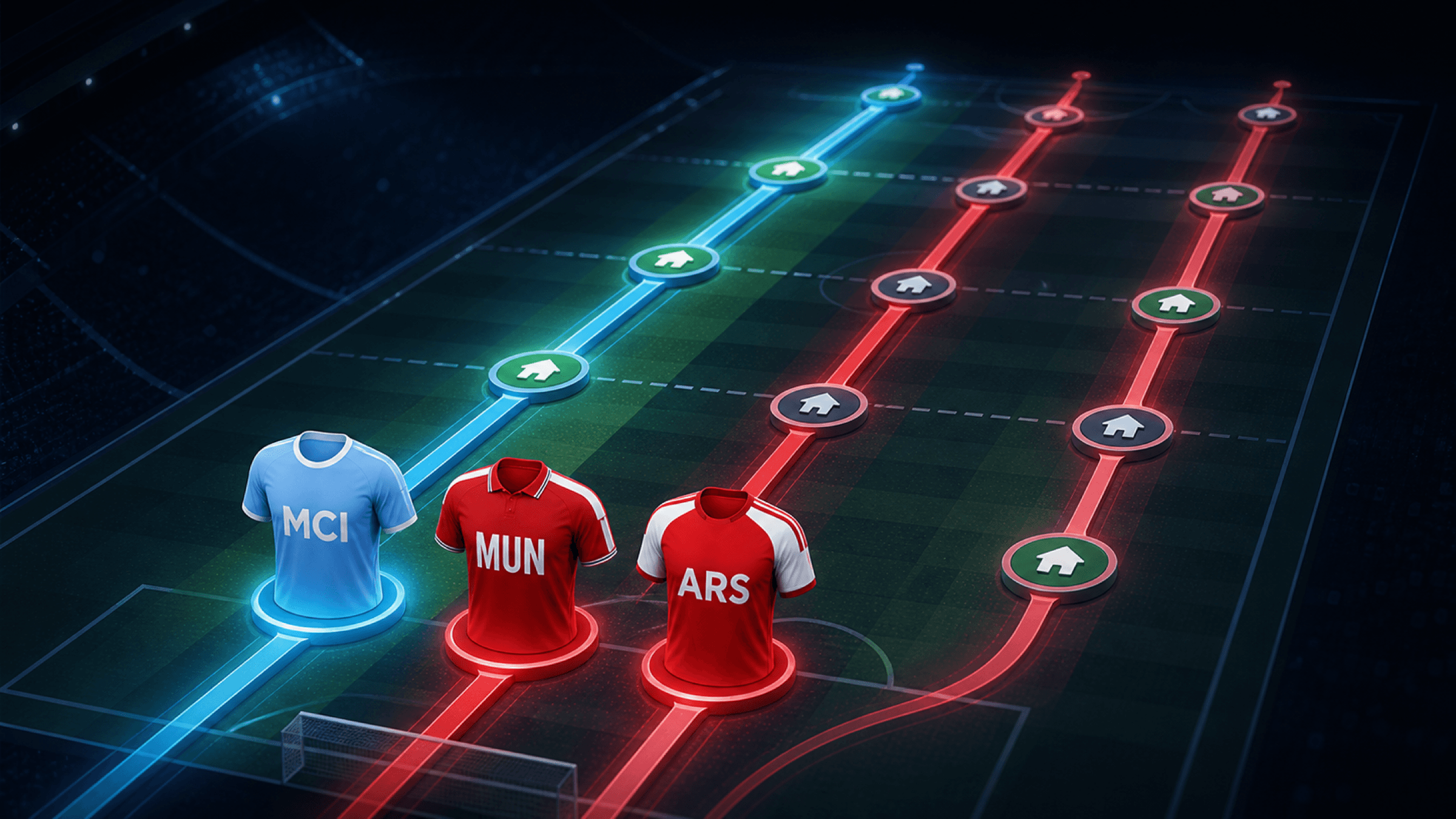
Target Manchester City first for attacking upside, with Manchester United offering the best balance of fixtures and flexible prices. Arsenal remain compelling for defence, but managers should separate the strength of a team route from the minutes security of any individual player.
The fixture verdict
Manchester City own the strongest opening route. Bournemouth at home, Crystal Palace away and Coventry City at home give Haaland 24.62 projected points, while Cherki, Semenyo and Doku all clear 15 points across the three-match horizon. The concentration of upside is useful but creates a club-slot problem: every City attacker or defender competes for one of only three places, so managers should rank the access points rather than collecting the highest projections independently.
Manchester United are the best flexible alternative. Hull City away, Ipswich Town at home and Everton away support Bruno Fernandes at 22.31 xPts, Mbeumo at 16.25 and Cunha at 14.84. Arsenal begin with Coventry City at home before Aston Villa away and Chelsea at home. That is not uniformly easy, but their defensive projections remain elite enough to keep Gabriel at the top of the premium defender conversation.
Best attacks to target
City rank first because both the team path and the premium talisman point in the same direction. Haaland averages more than eight projected points per match across the horizon, and the two home fixtures offer the clearest captaincy access. Cherki and Doku reduce the entry price, but their expected minutes—68.5 and 72.1 respectively—mean managers are buying a share of the attack with greater substitution risk.
United rank second but may be easier to build around. Bruno carries premium-level projection without Haaland's £15.5m price, Mbeumo supplies an £8.0m route and Cunha offers another player at the same price. Arsenal are third: Saka projects 16.82 points and Gyökeres 14.24, but both carry lower expected minutes than the most secure premium names. Brentford are the value team to monitor, with Spurs at home, Leeds away and Sunderland at home supporting Thiago at 15.14 xPts.
Concentration is the main attacking risk. City and United dominate the early list, so a squad can become exposed to one postponed fixture, unexpected rotation pattern or weaker-than-modelled team start. Diversification is not automatically superior, but the third slot from one club should beat the best alternative by enough to justify losing access elsewhere. That comparison matters most when a £7.0m–£8.0m midfielder and a defender are competing for the same final club place.
- 1. Manchester City — BOU (H), CRY (A), COV (H).
- 2. Manchester United — HUL (A), IPS (H), EVE (A).
- 3. Arsenal — COV (H), AVL (A), CHE (H).
- 4. Brentford — TOT (H), LEE (A), SUN (H).
Defensive routes: projected points across the opening three
Four representative defenders from the frozen fixture-route snapshot, ranked by Gameweeks 1–3 expected points.
Key takeaway: Gabriel and O'Reilly are separated by only 0.41 projected points, with both comfortably above Dalot and Robinson in this snapshot.
View chart as a data table
| Gabriel | 17.99 pts | 89.6 xMins |
|---|---|---|
| O'Reilly | 17.58 pts | 84.9 xMins |
| Dalot | 13.45 pts | 79.2 xMins |
| Robinson | 12.98 pts | 68.8 xMins |
Best defences to target
Manchester City and Arsenal are the leading defensive routes, but they offer different trade-offs. O'Reilly reaches 17.58 xPts at £6.5m with 84.9 expected minutes, while Gabriel reaches 17.99 at £8.0m with 89.6 expected minutes. Gabriel therefore costs more but presently carries the cleaner individual-role profile. City also have Guéhi and Matheus Nunes above 14.8 xPts, reinforcing the team route while intensifying the three-player limit decision.
Fulham provide the budget contrast. Robinson, Sessegnon and Castagne all sit near 12.8–13.0 xPts across Chelsea at home, Sunderland away and Crystal Palace at home. Their prices make rotation easier, but expected minutes differ materially: Castagne is at 79.5 per match, Robinson 68.8 and Sessegnon 57.9. United's Dalot projects 13.45 at £5.0m and is the most direct way to combine a favourable fixture run with a mid-price defensive slot.
Goalkeeper spend tells the same story. Raya leads the position at 12.82 xPts, Donnarumma follows at 12.15 and Leno reaches 10.81 for £4.5m. Paying £1.5m for roughly two projected points can be correct when the rest of the team is settled, but early drafts often gain more by moving that money into a secure outfielder. Defensive-route rankings should therefore be read alongside the marginal upgrade the same budget buys in midfield or attack.
Fixture swings
The opening swing favours teams that combine one difficult match with two strong targets. Arsenal's Villa and Chelsea fixtures prevent a simple green-run label, yet Coventry at home is strong enough to keep their premium assets relevant. Fulham improve after Chelsea, moving into Sunderland and Crystal Palace. Brentford's route becomes particularly interesting from Gameweek 2, when Leeds and Sunderland follow the Spurs opener.
The teams to treat cautiously are those whose best individual price disguises a weaker sequence or insecure role. Bournemouth start away to City before Everton at home and Newcastle away. Liverpool have Newcastle away, Forest at home and Ipswich away: the route improves, but the first match lowers the immediate appeal of paying a premium. Fixture planning should therefore include an exit or bench decision, not just an entry point.
Planning the transfers
Managers starting with triple City should decide which slot is expendable before the deadline. Haaland plus one attacker and one defender creates balanced access; Haaland plus two midfielders maximises attack but removes the O'Reilly route; going without Haaland demands a captaincy plan rather than merely spreading funds. United can then absorb the released budget through Bruno, Mbeumo, Cunha or Dalot at several price points.
The opening choice was between Arsenal’s premium defensive route, Fulham’s lower-cost defenders and Brentford’s improving run after Tottenham. A player with uncertain minutes could still be a poor way into an attractive schedule. The retained forecast covers three matches, so its conclusions do not extend automatically to a longer holding period.
Plan the first review point as well as the first purchase. A three-match horizon does not require selling after Gameweek 3, but it prevents one attractive opener from disguising two difficult fixtures. For every selection, record the expected holding period, likely bench weeks and a replacement at a similar price. That turns the fixture table into an actionable transfer plan and reduces unnecessary early churn.
Gabriel and O'Reilly illustrate the distinction: only 0.41 projected points separated them across the opening three, while their prices differed by £1.5m. A squad needing that money elsewhere had a clear reason to prefer O'Reilly. A squad valuing Gabriel’s higher minutes estimate could justify the premium. The fixture colours alone could not settle that decision.
How this article was checked
Team routes are derived from the accepted FPLRogue xPts v1 player projections generated on 6 August 2026 and official FPL fixtures for Gameweeks 1–3. Attack comparisons use the leading credible-minute midfielders and forwards; defence comparisons use goalkeepers and defenders. Player examples include expected minutes so a strong team route is not mistaken for a guaranteed individual start. Ratings and projections should be refreshed after transfers, injuries or postponed fixtures.
- FPL Rogue data and models — Three-Gameweek player projections, prices, ownership and expected minutes.
- FPL Rogue data and models — Accepted model engine, version and projection freshness.
- Fantasy Premier League — Official players, prices, positions, teams, availability flags and Gameweek deadline.