Skip to content
FPLRogueNewsroom
Command CentreGet Android app
LatestFPL Gameweek 1 targets: four routes for opening squads

Best FPL budget defenders and £4.5m enablers for 2026/27

Fulham supply four of the leading £4.5m projections, but expected minutes separate secure enablers from attractive rotation risks.

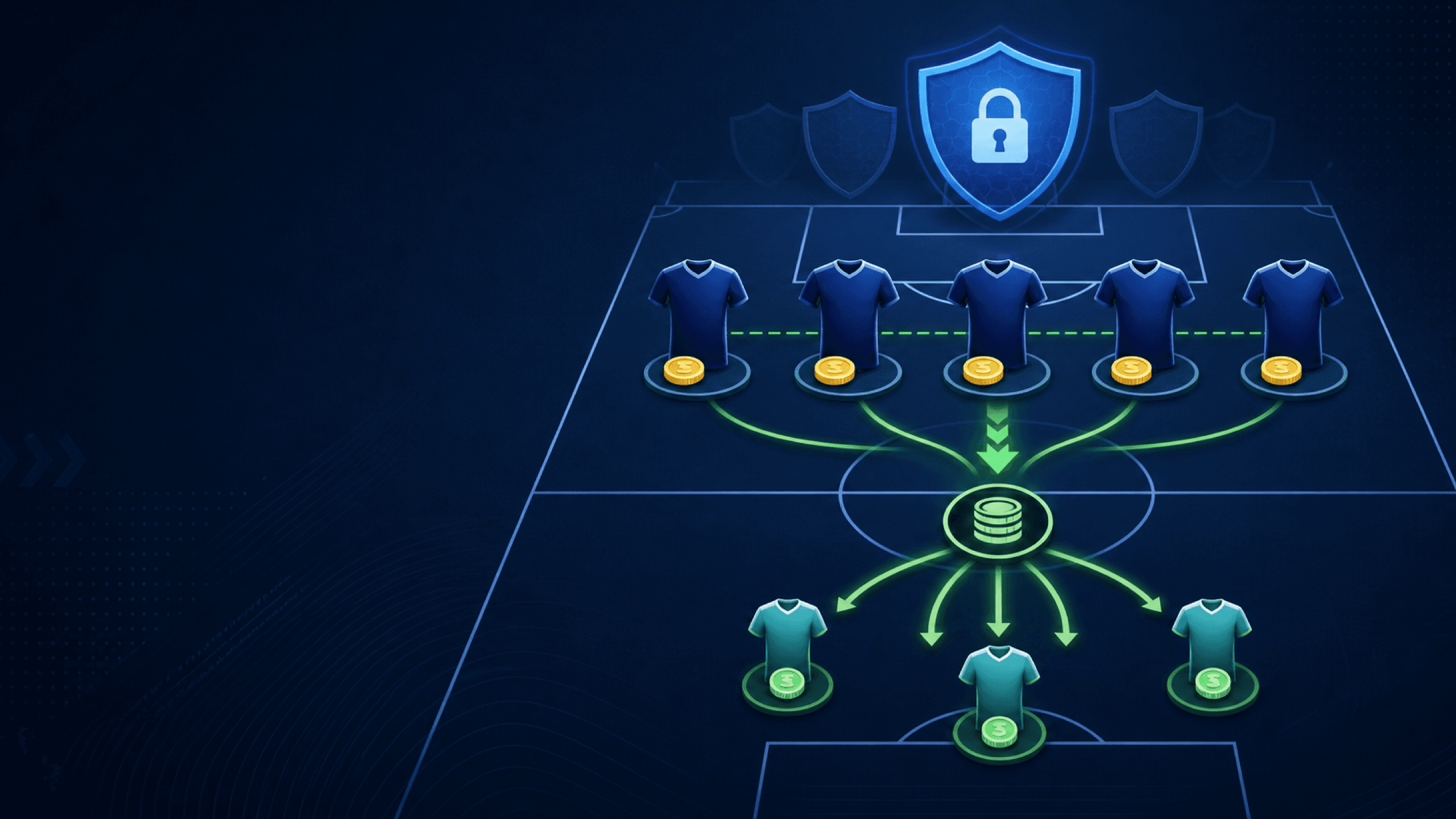
Five generic defensive shirts connect value tokens to money released elsewhere in a fantasy squad.
AI-generated illustration: FPLRogue
Answer first

Robinson leads the £4.5m defender projection at 12.98 xPts over the opening 3 gameweeks, closely followed by Sessegnon, Castagne and Bassey. Castagne, Bassey, Kadıoglu, Shaw and Kayode offer the cleaner current minutes profiles; choose the saving only when it funds a named upgrade.

The price-band verdict

The £4.5m bracket is deep enough to build a playable defence, but the top raw projection is not automatically the best pick. Robinson leads at 12.98 xPts (GW1-3) with 68.8 expected minutes; Castagne projects 12.81 at 79.5 and Bassey 12.35 at 89.6. The latter profiles trade a small amount of model upside for stronger time on the pitch.

A price band is a squad-construction tool, not a claim that every player at the same cost performs the same job. Start by defining the band and position filter, then compare xPts, xMins, start probability, ownership, role and fixture horizon. A chart sorted only by central projection can hide that the top name is a volatile substitute while the next name is a reliable starter.

The second test is replacement cost. Ask what happens if the pick loses his place or suffers an injury. A dense price point with several viable pivots is easier to manage than an isolated player who requires two transfers to replace. Money in the bank can protect that pathway, but unused money should have a documented purpose.

Reader-facing rankings should show the trade-off, not only the order. For each candidate retain official price, expected points, expected minutes and the factor most likely to invalidate the pick. A secure player can rank below an explosive one and still be the correct choice for a fragile squad. Conversely, a strong bench can make a calculated minutes risk worthwhile. This is why the article gives structures and review triggers alongside the chart.

Premium options

Gabriel at £8.0m remains the premium benchmark with 17.99 xPts and 89.6 xMins. The budget defender decision should therefore be framed as an upgrade trade: does moving from a £4.5m defender to Gabriel gain more than spending the £3.5m in midfield or attack? One premium anchor can coexist with several enablers when the enablers play.

Premium spending buys some combination of captaincy, reliable minutes, team strength and multiple routes to points. It should not be justified by price itself. Compare the premium with the best budget alternative plus the exact upgrade created elsewhere. If the combined alternative scores more over the planning horizon and preserves captaincy, the premium can be omitted.

Club limits create another opportunity cost. A premium defender or goalkeeper can block an attacker from the same team, while a cheap enabler from a strong club may consume a scarce slot. Rank routes within each club before comparing across price bands. This is especially important for Manchester City and Arsenal in the opening model.

Price-band analysis should be rerun after every official price, position or club change. Historical points can provide context but must not be substituted for the current role. When a player transfers, the previous projection becomes non-portable until team attack, defence, fixtures, set pieces and competition are recalculated. If that recalculation is unavailable, remove the player from the ordered shortlist and explain the evidence gap.

Data visualisation

£4.5m defenders by three-Gameweek xPts

Expected minutes shown in notes.

Key takeaway: Expected minutes shown in notes.

View chart as a data table
£4.5m defenders by three-Gameweek xPts: complete data table
ItemGW1-3 xPtsNote
Robinson12.98 pts68.8 xMins
Sessegnon12.89 pts57.9 xMins
Castagne12.81 pts79.5 xMins
Bassey12.35 pts89.6 xMins
Kadıoglu12.09 pts83.5 xMins
Shaw11.98 pts83.8 xMins
Kayode11.96 pts88.0 xMins
Source: FPL Rogue data and modelsCaptured 6 Aug 2026, 15:40 BSTModel xpts_v1:dc-3.1:3651510ccfd5

Mid-priced options

At £5.0m, Dalot projects 13.45 points with 79.2 expected minutes and Van den Berg 12.92 with 84.1. The gain over the best £4.5m group is modest in this horizon, so role and attacking involvement must justify the extra £0.5m. Avoid paying mid-price merely for a familiar club.

Mid-priced players often provide the easiest transfer flexibility because adjacent options are plentiful. Their role is to deliver starter-level points without requiring captaincy. Prefer secure minutes and repeatable involvement over a pre-season scoreline. If two players project similarly, the one with clearer set pieces or a more stable starting position generally provides the better floor.

A mid-priced pick can still be structurally awkward when two teammates compete for the same FPL slot or when the next move requires selling a premium. Map at least one upward and downward pivot. The editor should show readers what new evidence would trigger each route instead of offering a static list.

The planning horizon should match the intended transfer cycle. Opening squads can look across six fixtures while the embedded model chart covers three; state that difference and avoid presenting the shorter ranking as a season forecast. A player with a difficult first match may still be the better hold, and a one-week bargain may create an immediate transfer booking. Future moves have value because free transfers are scarce.

Budget options

Robinson, Sessegnon, Castagne and Bassey make Fulham the deepest current £4.5m pool, but selecting two defenders from one team concentrates clean-sheet risk. Kadıoglu, Shaw, Kayode, Justin and Hume provide alternative routes. Sessegnon's 57.9 xMins is the clearest reminder that attacking potential does not remove start risk.

Budget value is created by credible minutes and the upgrade funded elsewhere. A minimum-price player with no route to the pitch is not an enabler when he is first off the bench. Separate starters, rotation options and pure placeholders. Expected minutes is the fastest first filter, but current injury, transfer and friendly evidence can override a stale model input.

Ownership can reveal where a failed assumption will be widely shared, but it is not proof of quality. A highly owned cheap player may protect rank while creating the same weakness in many squads. A low-owned option may be a genuine discovery or simply less secure. Keep the decision grounded in role, minutes and price pathways.

Bench order is part of the price decision. The first substitute needs the strongest combination of appearance probability and points when called; the cheapest player is not automatically last. Avoid pairing a volatile starter with a non-playing substitute in the same position. One unexpected absence should still leave a legal formation, and two absences should not force an early hit unless the structure consciously accepted that risk.

  • Security route: Bassey — 89.6 xMins.
  • Balanced route: Castagne — 12.81 xPts, 79.5 xMins.
  • Upside route: Robinson — 12.98 xPts, 68.8 xMins.
  • Alternative clubs: Brighton, United, Brentford, Leeds and Sunderland.

Best squad structures

A robust opening defence uses one or two high-confidence starters, one upside pick and at least one bench defender who can genuinely appear. If the saving buys Bruno instead of a mid-priced midfielder or turns a weak forward into a secure starter, the enabler has a job. If the money simply sits unused, select the better player. Recheck every £4.5m role after the final friendlies.

A complete structure must satisfy the £100.0m budget, position quotas, three-per-club rule, legal starting formation and four-player bench. Test it with one unexpected absence and one planned transfer. If a single benching breaks the formation or forces a hit, the savings have been overused. A modestly lower projected starter can be worth selecting when he protects several future decisions.

The final review should refresh prices, positions, team assignments and availability from official FPL, then rerun the model under the current fixtures. Confirm that chart values, prose and social summaries use the same snapshot. Name the premium or flexibility bought by each enabler; if the answer is unclear, select the stronger player rather than the cheaper one.

For the final editor pass, rebuild the example allocation from zero rather than trusting arithmetic carried through revisions. Check all fifteen positions, total cost, club counts, starting formation, captain, vice-captain and bench. Then compare the final names with the chart snapshot and current official data. This mechanical check catches duplicate club slots, stale prices and recommendations whose written rationale no longer matches the selected structure.

Finally, separate editorial confidence from model rank. High confidence requires current official team and availability data, a credible role, a legal example structure and a chart generated from the same snapshot as the copy. Medium confidence is appropriate when minutes or tactical usage still needs final verification. Low confidence means the name belongs on a watchlist rather than in the ordered recommendations. Recording that state helps later automation refresh only the claims whose evidence has actually changed, while leaving stable rules and structural guidance untouched. Keep an explicit review timestamp beside that confidence so readers and editors can tell whether a late team-news change has already been incorporated. If confidence differs by player, show it on the individual recommendation rather than applying one blanket label to the entire band.

Evidence and methodology

How this article was checked

Players are grouped by the official £4.5m price and ranked on the frozen three-Gameweek model. Expected minutes and the use of the saving are part of the recommendation; final availability remains mandatory.

  1. FPL Rogue data and modelsFrozen three-Gameweek xPts, xMins, start probability, price and ownership.
  2. FPL Rogue data and modelsAccepted engine, recipe and methodology status.
  3. Fantasy Premier LeagueOfficial player, team, price, position, status and GW1 deadline data.

Next decisions

Keep building your Gameweek plan

Best FPL budget defenders and £4.5m enablers for 2026/27 | FPLRogue Newsroom